Blog

Carers’ Group: 8th October

We welcomed a new member to the group this evening. We had far ranging discussions, on a variety of topics, as usual.

  • Our first speaker highlighted some of the difficulties of coping with your own issues while being a carer. Our friend had  six hospital appointments in one week, giving rise to stress and seemingly endless travel and delays while waiting to be seen. Added to that, letters mistakenly demanding money contributing to anxiety. The need to take the person being cared for to a tricky hospital appointment is “just” another layer of stress.
  • The second speaker thanked Janet for raising points about reviewing a diagnosis, when experience raises questions about the type of dementia a person has. Their mother had returned to the memory clinic and had been told she actually has Vascular dementia and Lewys Bodies, with a possibility of Alzheimer’s – instead of Alzheimer’s with Vascular dementia. The key result is that the medication has been changed and their mother is much calmer and less prone to hallucinations.
  • Our new member discussed the issues his father had with being moved out of a care home, into hospital and then into a new home with continuing care payments. We have discussed the financial impact of care in previous sessions. The NHS provide guidance on continuing care funding here.
  • The final discussion was around changing reactions to living at home with a fluctuating number of long term (family) guests. Whereas, in the past, the person with dementia had been happy in a lively family environment, now they had difficulty keeping-up with conversations and keeping track of who was who. A quieter home might be the answer, but husband and wife living just as a couple would be a big change for both of them – would it work? would they be bored? Recognising and coming to terms with the “new normal” is a challenge.


I then presented the following, before our regular 10 minute meditation session.

Benefits of reminiscence therapy for dementia

Reminiscence therapy can give people with dementia a feeling of success and confidence because it’s something they’re still able to do. It gives them an opportunity to talk and share something meaningful rather than just listen.

Talking about happy memories of the past also brings joy, which is especially helpful if someone is having a hard time with everyday life – it helps them cope with stress.

The difference between reminiscing and remembering

Reminiscing is not the same as asking someone to remember something from the past.

Remembering something specific, even from long ago, can be stressful for someone with dementia because they’re likely to feel pressured or put on the spot. In contrast, when a pleasant memory floats up and they share it with you, they’ll feel good.

For example, a pwd might not remember right away when you ask even a simple question like “Where did you grow up?” But if you’re looking through old photographs, they might spontaneously say “Oh look, there’s my house. My mom baked my favourite cakes every Saturday. They were so good.”

What to do if reminiscence brings up painful memories

You never know which memories will come up when reminiscing about the past. Sometimes a painful or unhappy memory will surface. This isn’t necessarily a bad thing, but you’ll need to respond with kindness and understanding.

You know your pwd best so if this comes up you’ll have a better idea of whether it’s best to listen and offer support so they can feel better by telling the story or if it’s wiser to kindly steer them toward a happier memory so they won’t get stuck in a sad, distressed state.

How to make reminiscence therapy successful

The goal of reminiscence activities is to enjoy time together and set the stage so your pwd has a chance to talk about any memories that come up.

For best results, plan for a time of day when they’re most interested in activities, maybe earlier in the day. Choose a quiet, comfortable location where they’ll be able to hear and see you well.

If your pwd doesn’t recall any memories during the activity, that’s ok – maybe nothing came to mind at that moment. You could offer comments about yourself that might help spark a memory for them (like “This reminds me of going dancing”), but there’s no need to pressure them. With or without reminiscing, they’ll still enjoy these activities.

4 reminiscence activities

Memories can be associated with different parts of the brain, so it’s helpful to try activities that stimulate different senses. This is the time to use your imagination and get creative.

1. Listen to their favourite music
Music helps people reminisce and relate to emotions and past experiences. That’s why it’s often recommended for those with dementia. Music can even reach pwd at a very advanced stage.

You can play their favourite songs, have a little sing-along, or play music on simple instruments like shakers, bells or tambourines, or a DIY drum.

2. Look through photos or keepsakes
Pictures or keepsakes that bring back memories are another excellent way to reminisce. Photos of family, friends, and important life events are always good choices.

Photos of things that remind them of favourite hobbies are also great. For example, someone who loves to garden might enjoy looking at a gardening magazine or plant catalog. Someone who loved to cook might like a gourmet magazine with beautiful food photos. The same goes for sports, crafts, historical events, etc.

3. Smell familiar scents and taste favourite foods
Smell is a powerful way to access memories. You could create scent cards or jars with smells that remind them of favourite foods (use spices) or a location like a pine forest near their childhood home (use fresh pine needles or pine scented sticks.

Taste is another way to evoke fond memories. Maybe they always made a special dish for holiday celebrations – you could make it for them and reminisce while eating together. Or maybe you could recreate a favourite snack they made for you as a treat when you were young.

4. Enjoy tactile activities like painting, pottery, or other crafts
Touch can also remind someone of the past. Familiar tactile activities like drawing, painting, pottery, knitting, sewing, or other crafts can spark old memories. Even if they can’t participate in these hobbies anymore, doing things like touching paintbrushes, swirling watercolours, scribbling with drawing chalk, squeezing yarn, or playing with fabrics can evoke strong memories.

Another way to use touch is through objects. Maybe wearing or handling favourite pieces of jewellery or accessories (like a watch or a necklace) would bring up memories of significant life events. Other ideas would be to bring out a significant piece of clothing (maybe a dress or suit) that they use to love or wear to important events.

 

Gone to the dogs

or rather, they came to us…

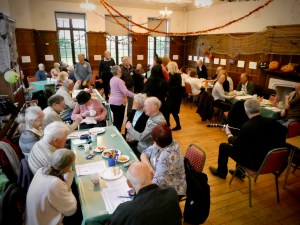
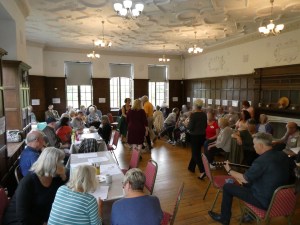
Another record turn-out of 49 group members, plus volunteers, plus our special guests.

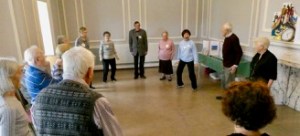
First today we have to thank Chew Yeen Lawes for giving us a couple of brief introductory Tai Chi sessions.

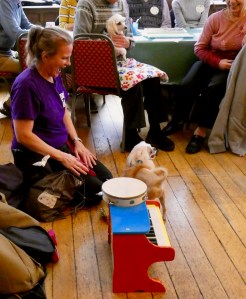
Then we had the very much in-demand Nightingale Dogs. They provided some interactive games, tricks and calming cuddles!

Our group was a little larger than the dogs are used to, but they coped wonderfully, with a little help from Jenny and Tim

They managed to visit all the keen dog lovers in the group.

Thank you to everyone who came and we hope to see you next time.


55 party people

We welcomed ten new people to the group today! We equalled our highest turn-out with 47 members, plus 6 volunteers, a guest and a singer.

Our singer, the excellent Tony, took the opportunity to tune-up, before launching into a rousing sing-and-dance-a-long.

It was lovely to have Leanne from the Alzheimer’s Society visit the group and give some expert advice to some our members. Leanne’s group runs on the alternate Tuesdays from us.

See you next time.

All the best,


Carers’ Group: 9th September

Janet introduced the session as usual.

News

  • The Reflections Friendship Group has been assessed for the Dementia Inclusive Greenwich Award by the Dementia Action Coordinator for Greenwich and one of her assessors (who has dementia). The Commissioning Manager Older People for Greenwich also came along to see the assessment and discuss our work. We should receive feedback on the assessment soon. For more information on Dementia Friendly Greenwich, visit the Greenwich Community Directory here.
  • We were very pleased to announce the Reflections Reminiscence Project. The project will start in November/December, run monthly and will have a specific theme to each session. We will start with Christmas. Participation in the project is open to members of the Friendship Group, living in Greenwich, who would benefit from active participation. We aim to have a friendly, fun, atmosphere from the outset – we hope to have many of our current volunteers joining the project. The project follows-on from Peter’s 10 week “apprenticeship” with the Remembering Yesterday, Caring Today (RYCT) programme. More information on that here. We are very grateful to the Rotary Club of Greenwich for providing some funding to run the project. The Rotary Club magazine for August/September highlights the organisations interest in dementia see here.
  • Janet has discussed the Carers’ Group with the Commissioning Manager Older People for Greenwich, who will be promoting the group to Social Workers in the borough.

Group Discussion

One carer noted that her mother had become a lot less violent since her medication had been changed. This was good news, not least because it meant her carer might withdraw her resignation. The daughter also mentioned that the specialist was reviewing her mum’s diagnosis as they now thought she might have Dementia with Lewy Bodies (see here for more information on Lewy Bodies).

We then had a discussion on when it was appropriate to consider a move into a care home and the different types of services offered by homes. A summary of the differences may be found here. Age Uk has a guide on how to choose a care home and questions to ask when looking around (see here).

The group moved on to consider the pressures of caring for someone with dementia 24 hours a day and the benefits of joining activity groups and respite care. A member said her mum had used Volcare, and Miss Mardle and was about to try Oxleas Art Therapy.

We talked about the lengths carers sometimes need to go to ensure their loved-one eats and drinks, and how to react when they refuse to take anything. There were hard questions around an expectation that people should do everything to prolong life and about quality of life. The Social Care For Excellence site has information on eating well with dementia here.

Then we discussed issues around disinhibited actions in care homes and when it turns into a safeguarding issue. The Social Care For Excellence site has information on this and other challenges here.

Educational topic: Coping and Adjusting to Change

Life presents us with challenges/learning experiences. Some we may willingly embrace such as a new hobby, others we may not choose such as experiencing someone we care about living with dementia

Whatever the experience, recognising we do have a choice how to feel is empowering.

The brain is a huge computing machine capable of imagination and generating a wide range of emotions. These can be fleeting or they may stay longer. If you don’t like how you are feeling, consider that you can choose to change this. Something may upset you, this is natural as we are feeling beings. However we either choose to carry on feeling sad or we can review the situation, choose to let it pass and move on. Meditation shows that thoughts are transient constantly being replaced.

This is no different to supporting someone on their dementia journey. Perhaps the person with dementia (pwd) starts doing and saying things that you find upsetting. Your reaction to this can make a huge difference to you both.

  • Firstly recognising the pwd may be unable to moderate the way they are behaving, due to impaired logic, reasoning or disinhibition, can make a difference to how you respond. Also remember that you are not responsible for anyone else only yourself.
  • Ask your self how do I feel about this?
  • Is it something I really feel I should challenge?
  • If you do consider you should, maybe ask yourself why and is it really going to benefit either of you?
  • Look at your feelings? Does it help either of you if you feel angry or upset?

An example – perhaps the pwd is a disinhibited man and is kissing ladies hands and you feel embarassed about this. Consider why? Perhaps you are imaging they would be mortified if they knew what they were doing. The point is they are not the same person they were no more than we are. The experiences life brings changes us. Additionally if other people are understanding and accepting and no one else is upset, is it helpful to yourself to be upset on their behalf especially if the pwd is content?

  • Consider how you might look at things from a different perspective?
  • Maybe put yourself in the position of a friend being told about the experience. How might you help them? What other perspectives could you offer?

We have been talking about dementia but the technique of perspective can be used in any situation. Recognising in any situation you can choose an alternative is powerful. It may take time to change but you can if you wish to.

Some strategies :

  • Consider talking to someone you trust and value. This may bring another perspective.
  • If the issue is dementia related perhaps using the online forum Talking Point on the Alzheimer’s Societies website might provide examples of how others have coped in a similar situation.
  • Think about where else you might find an answer.

To end: meditation

As usual, once the group session had finished, people had the opportunity to take part in an optional 10 minute guided meditation. Everyone took part, and said how calming it was.


The Forever Young Festival

The Forever Young Festival at The Stables/Charlton House was bigger than ever. Reflections had a stall again this year. It was lovely to see so many of our group there. Janet and I enjoyed a full day chatting to people and taking-in the atmosphere.

We had recommended the group’s friend Jamie and his appearance certainly turned heads.

He performed several times, in different costumes.

A few people from our Friendship Group joined-in dancing to Jamie with Janet. It was a very nice day for everyone.


All new

42 members today welcomed Hanna H to the group.

Hanna sang some songs and invited group participation with a variety of instruments.

There was even a little dancing.

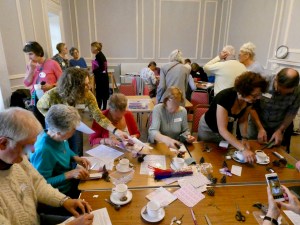
In the quiet room people were hard at work, with Pearl, making greetings cards (and very good they were too).

We look forward to seeing you, at our next session, on the 18th September.


Jamie – Viva Las Vagas

We had 44 group members today – all to see Jamie giving his all in his Viva Las Vegas Show which he did. We also had an impromptu visit from the Pearly Queen of Royal Greenwich, who was incognito, which was lovely.

There were a lot of costumes

Dolly Parton was popular.

Elvis arrived, but later left the building.

Everyone had a very good afternoon. Can you spot the pearly Queen dancing?


See you next time,

Carers’ Group: 13th August

Janet, Tatiana and I welcomed five carers to the group this evening. There was a full session of discussion.

I spoke about the Forever Young Festival at The Stables on 7th September. It follows on from last years successful event – this year it will be even bigger and better. It will run from 11am to 4pm and Reflections will have a stand there. It should be a very good day. More information when available.

I also spoke about the visit from Gaia, from the Greenwich Fire Brigade, who came to our recent Reflections Friendship Group to talk about a new a pilot in Greenwich and 4 other  London Boroughs called Fire, Safe and Well. The Fire Brigade is keen to visit any residents that are likely to be at more risk of fire (for example: people living alone, aged over 60, living with a long term illness or health condition, have a mental health condition). The Fire Brigade will visit the person’s home to provide personalised fire safety advice, installation of a smoke alarm, carbon monoxide alarm and a heat alarm. Unlike a smoke alarm, the heat alarm can be installed in the kitchen and can detect when the temperature in the kitchen rises to an unsafe level, usually before a fire is started eg if a saucepan boils dry.   They can also offer safety advice plus refer people to relevant health and well being services if appropriate. The visits are free. If you want more information, please contact us.

Janet spoke briefly about two carer experiences which had come to her attention.

She informed the group it has been confirmed by the council’s funding manager that Meadows House Residential and Nursing Home (Kidbrooke) is THE dementia  provider in the borough for providing day care. The Meadows is expected to be able to cope with people with severe and challenging dementia.

She also mentioned a carer who had been to the group previously whose husband had recently died. The care in his last weeks had been in both The Woodlands Unit and the Queen Elizabeth (QE) hospital. The carer had reported to Janet she was upset that no one would help her in the last few weeks of his life. Janet had pointed her in the direction of both Advocacy for Older People and PALS both of whom said they could not help. Janet informed the group that if ever they were concerned about the care being delivered to their loved one to be persistent in flagging their concerns. If they couldn’t get help Reflections wanted to know about it. For her part Janet is making enquiries as to why this carer could not be helped by those organisations and who carers can reasonably expect to help them in finding their way round the health systems.

Group discussion:

Heatwave

The recent heatwave had been a problem for several people. Dehydration and loss of appetite can, and does, cause rapidly debilitating effects. Group members made suggestions on how to tempt loved ones to eat and drink. The most effective solution used was to leave small items of food and drink around the rooms being used. This led to nibbling when passing, over time the food disappeared. A member had needed to call out her mum’s Community Treatment Team – who were excellent in providing lots of help and equipment (her mum does not live in Greenwich). The break in the weather appears to have reset everyone to their previous state, with a return of appetite.

Help

Separate from the issues with heat, a member told us about the good work of local social services, who were called out to help when her father-in-law was confused and distressed in the local pharmacy. The result has been an assessment, support in the home, and some more pills.

Change

A common theme was the need to ensure treatment and support was regularly reviewed. People change over time and in response to their environment/weather etc – yesterday’s solutions are not necessarily today’s solutions.

Care homes

We have members caring for loved ones in early/middle/late stages of dementia. This gives the group a wide range of experience. A member who is taking initial steps to find a care home for their mum spoke about the wide range of homes out there. The group were keen to emphasise the need for a home that met their loved ones needs – where the staff were caring and aimed to provide person centred services. It is not the cleanest, tidiest, sweetest smelling, most organised home that necessarily provides the best environment.

Initial experiences of dementia

At the other end of the dementia “journey” we discussed the issues arising when people with dementia initially start to behave somewhat differently. Problems can arise because those around the individual are ignorant of how the dementia is affecting that individual and how they should respond. This can result in denial, confusion, arguments, stress, isolation and depression. Everyone loses. A key suggestion from the group was: knowledge and experience – hard to gain in a short period! Having understanding and being dementia aware can ease everyone’s experience. It is also necessary to consider wether some of the issues can be treated and resolved – depression, for example along with whether how the carer is interacting may be triggering some of the behaviour from the person with dementia.

Anxiety

A common question faced by all members is “when am I going home”. This may well mean that the individual is anxious. ‘Home’ represents familiarity, safety and security. If we are in unfamiliar surrounding, with strangers, we may all feel anxious. Just because someone has lived at the same address for 30 years and are surrounded by loved ones, does not mean they recognise their situation. Coping strategies suggested included: distraction, changing the subject to something more reassuring and familiar; and taking the hint and maybe acting as if “going home”.  This may mean a walk or a drive, thereby reducing stress and (hopefully) enabling a relaxed return to the current home in due course. 

Urine Samples

Finally, for this blog, urine infections can be a common occurrence for some people with dementia. If you have difficulty getting urine samples from your loved one, you might find The Bidet Bowl helpful. More details are here.


Tony and The Fire Brigade

It was hot, very hot. Then it started to rain, heavily. Fortunately, we had couple of guests and and everyone was kept busy – and dry.

First we had a brief talk from Gaia, the Community Safety Advisor from the Fire Brigade in Greenwich, about Fire Safe and Well – the new pilot project being trialled in five London Boroughs including Greenwich. The pilot is available to anyone over 60 or with a long-term health condition. She brought along fire safety devices, including a new heat alarm, which people are given free as part of the visit. After the talk Gaia spoke to people individually and we were pleased several people booked visits. You can find out more information about the Fire Brigade here

Tony came along today courtesy of funding from Music in Hospitals and Care and gave us another rousing rendition of some of our favourite songs.

As it was too hot to dance, Tony was able to circulate around the room and get up-close and personal.

Another good afternoon.

Jamie sings – In The Summertime

We welcomed back Jamie, following his highly successful first appearance a few weeks ago. Today he managed 13 costume changes and, once again, wowed the audience.

Here is Jamie in action and the happy singers and dancers.

The Big O

These boots were made for walking

Not sure about this one (Marge Simpson?)

Fortunately we had Dan on hand to test people’s blood pressure. You can find out more about this free service and Live Well Greenwich here.