Another busy group today and we were very pleased to welcome three new people.
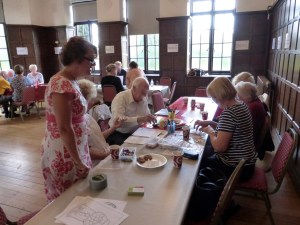
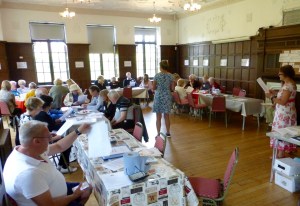
25 Friends came along for some archery, quizzes and a chat.
We are very grateful to Marc for managing to squeeze in another visit in his busy schedule. His archery sessions always prove popular, with new customers and veteran archers.
Janet has found a source of excellent quizzes. These proved popular, so we will be doing more of them in future. And we’ll make sure we give out the answers before everyone goes home – it’s clear that people are keen to know what their score was – and what were the answers they didn’t know: like the name of the first Russian dog in space.
Thank you to Sarah, Marc’s wife, for donating the skittles. The biscuit stock was also replenished with some welcome nibbles, thank you.
Angelika Welzel-Connolly, Dementia Action Co-ordinator for the Royal Borough of Greenwich, briefly introduced the Dementia Reference Group and gave out some information about the group (see here). Next time Angelika will return to answer any questions about the Reference Group and invite people to join.
As part of Dementia Dialogue Angelika will also run a knitting session that is guaranteed to produce wonderful results by 3pm!
For more information about Angelika and Dementia Dialogue see here.
Making Royal Greenwich a dementia-friendly Borough
You might be interested in Greenwich Council’s (slightly dated) guidance. You can find information on their web site here or read their pdf “A toolkit for business” here.
On the 11th July we celebrated the 1st birthday of the Friendship Group.
It was a lovely afternoon with 28 friends joining in the celebrations.
We had strawberries and fizz and Marc the archery coach came along again. Thank you to Bronwyn and Rob for supplying the strawberries, cream and bowls – Gloria and Martin for the cake – and Shrewsbury House for some fizz.
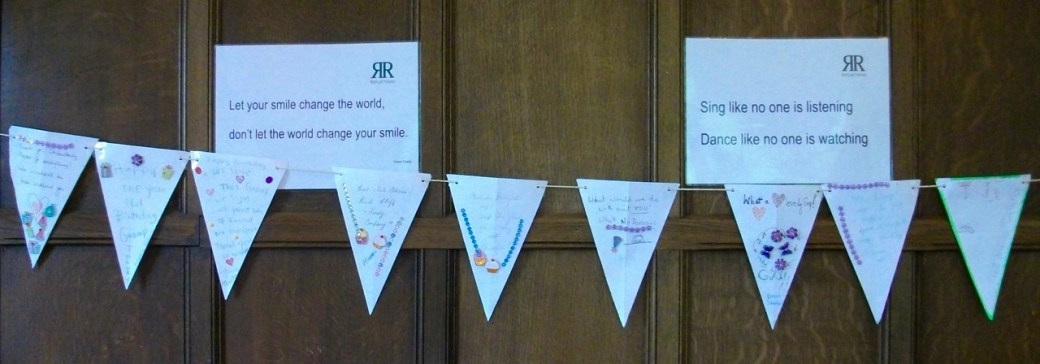
Some wonderful bunting was made by the group. It is too nice to display just once, so it will be displayed over the next few sessions.
Tina suggested the group could make some bunting for me. It was so thoughtful and I have displayed it at home.
As well as celebrating, it was also a time to remember and toast absent friends – those who can no longer attend for various reasons.
It was definitely an afternoon to lift the spirits. Thank you to everyone who has visited our group and especially to Deb, Tony and Thorntree School without whose donations we would not have been able to develop the group
The Royal Borough of Greenwich are holding a Dementia Awareness Event tomorrow Wednesday 17th May between 1.30pm and 5pm at:
The Stables, 76 Hornfair Road, Charlton, SE7 7BD.
Come along where you can find out about local dementia services and perhaps take part in the interactive sessions being provided. We are pleased to say we are taking part in this community event.
As well as talking to people about our groups we want to take the opportunity to talk about Hospital Admissions and John’s Campaign. All the NHS Trusts running local hospitals have signed up to be part of it.
So what is John’s campaign? John’s Campaign is :
“for the right of people with dementia to be supported by their family carers”
Queen Elizabeth Hospital
John’s Campaign was founded in November 2014 by Nicci Gerrard and Julia Jones. The Campaign is named after Dr John Gerrard, who died in November 2014 after a catastrophic stay in hospital.
Behind its simple statement of purpose lies the belief that carers should not just be allowed but should be welcomed, and that a collaboration between the patients and all connected with them is crucial to their health and their well-being. John’s Campaign applies to all hospital settings: acute, community, mental health and its principles could extend to all other caring institutions where people are living away from those closest to them.
In the time since the campaign was founded, over 1000 institutions have pledged support and a lot of progress has been made – but there is a lot yet to be done.
For their advice for carers see here. For more information about John’s Campaign see here
Hospital Statistics
The Alzheimer’s Society produced statistics in their 2009 report “Counting the Cost: caring for people with dementia on hospital wards:
Over a quarter of hospital beds in the UK are currently occupied by people with dementia
The average stay of a person with dementia is three weeks but it can be much longer if rehabilitation is a problem or there is no where suitable to go.
One third of people with dementia who go into hospital for an unrelated condition NEVER return to their own homes.
47% of people with dementia who go into hospital are physically less well when they leave than when they went in.
54% of people with dementia who go into hospital are mentally less well when they leave.
Tips to manage the patient experience
As per John’s Campaign, speak to the nurse in charge to let them know you are the main carer and to arrange open visiting. This means you will be able to visit outside of normal visiting hours if you want to.
Speak to the doctor in charge of the patient’s care. This can be requested via the nurse in charge. This is essential as the doctor will have the overall say as to what is going to happen. Doctors have a busy schedule but on request they will meet with you or give you a phone call. You can find out about the patient’s treatment plan and can then make it clear if you want to be involved in decisions around the patient’s care, and accompany them should they need to leave the hospital to go on any appointments or be transferred. You can also let them know about any concerns you may have about supporting the patient on their return home.
Before the patient returns home, a discharge meeting will take place. If you want to be included in this process, let the doctor know. This is the opportunity to make sure you have the right support to continue to care for the patient taking into account the recent changes. If you are not happy about something let them know. Your opinion is important and you do have a say.
A hospital social worker will usually be involved if a patient needs a care package to return home or special equipment. Again you can ask to meet with them.
You know the patient best. Be polite but assertive when speaking on behalf of the patient.
PALS – The Patient Advisory Liaison Service, is there to help. They can be found in every hospital. In the Queen Elizabeth hospital (QEH) they have their office at the back of the foyer. Tel: 020 8836 4592. Do speak to them if you have any concerns that you feel are not being dealt with e.g. on the ward as they can liaise on your behalf. Do not be afraid to contact them as they are there to help.
The QEH, has an Elderly Care Pathway Matron. She is another person you can ask to see to share your concerns. Tel: 020 836 5299.
Important – Do not rely on the ward nurses to pass on any messages. They are extremely busy and they may accidentally forget to pass on your message. Following the tips above may help prevent you from becoming stressed and feeling you are not being heard.
Also – If you are the main carer, have you given any thought as to what will happen if you become ill or need to go into hospital? Giving some thought to this now may help to give you peace of mind should this happen.
6 Carers attended the group with the other 2 regular carers providing notice they would be unable to attend this time.
The group started by briefly talking about Teepa Snow’s Gems model and how it can be helpful in recognising where someone is on their dementia journey. See here to read more about this and see Teepa’s video where she explains the Gems.
We talked about the power of music to make a connection with someone and as singing comes from a different bit of the brain to speech, people who struggle with conversation can usually sing well known songs.
The group were asked why it was felt necessary for 4 signatures including the power of attorney, to be required where a care home wanted to give medication covertly. It was explained as the person with dementia was under the care of the home, it was a legal requirement for them to do this even though the medication was essential and hiding it in food was in the best interest of the person with dementia.
A number of issues regarding care records were discussed:
Carers with lasting power of attorney for health should be able to view hospital and care home records.
Agency carers providing care in the home should ensure entries in their log sheets are factual ie recording the exact time of arrival and departure as these could be required for legal evidence should the need arise. Family members should review the log sheets from time to time so they can raise any queries if need be.
Where care is being provided at home by family members, it is not a requirement for a detailed record of the care being provided to be kept. However, it would be good practice to keep a diary of things out of the ordinary eg. if someone wasn’t very hungry or seemed more confused than normal, as this information could be helpful when discussing concerns with health professionals and it would not always be known at the time if something might be relevant later on.
The challenges of keeping track of what is going on where family do not live locally and care is being provided. A carer said she had used the Jointly app provided by Carers UK which provides an online diary and a quick way of writing a message which all people included in the group can see. Read more about the app here.
We finished by discussing hospital admissions and John’s Campaign. You can read more about this in our blog for Dementia Awareness week.
Dementia care expert Teepa Snow suggests a fascinating model to explain the stages of dementia. Teepa’s GEMS™ revolves around remaining abilities rather than capacity losses.
Read her detailed explanation of each precious stone and their attributes here.
The GEMS™ model uses sapphires, diamonds, emeralds, amber, rubies, and pearls to help us better understand people with dementia, their behaviour and how we might choose to respond.
It is a hopeful and helpful perspective on the disease and those who live with it and it provides a framework in which we can support and encourage people with dementia to live enriching lives until the end.
The analogy of a pearl in an oyster shell to describe the last phase of life with dementia is especially beautiful and fitting. Teepee says “If what you think you see is an ugly shell, remember to look deeper: the most important thing is what’s inside.”
Thank you to Seeking the Good Life, a carer’s blog post we follow, from who we learnt about this inspirational model here.
Back again, by popular demand, Tony gave us another excellent afternoon of entertainment. There was plenty of singing-a-long.
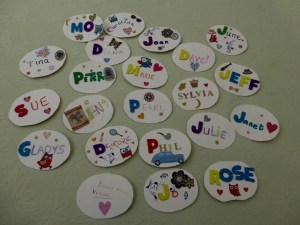
The badge making continues – they are all individual. What a creative group of people we have!
And finally. A really big thank you to Ellie and the Thorntree school dancers for a cheque for £206 for the group and thank you Sally for collecting it from the school. We will make sure the money is spent wisely.
It’s a shame I couldn’t be there to join in the fun. I hope to see you soon.
We were pleased to welcome back archery coach Marc. Archery was again very popular. With help and support everyone who wanted to, was able to have a go.
Other usual activities – bingo, dominoes and knitting also took place.
We were also pleased to welcome back Ellie. She had come along with her classmates on 7th March (see blog here) to do a sponsored dance routine, which she had choreographed. She announced the money is still being counted, though believes they have raised around £207 – which is wonderful.
I shall be taking a short break and hope to be back at the group in the not too distant future.
Janet and the team look forward to seeing you on 2nd May, when singer Tony Martin will be returning.
There were 8 carers at our second meeting including one new lady who commented after, the group was great and what she had been looking for, for some while.
Issues raised and discussed by the group tonight were:
Care homes: If the person with dementia is in a care home, is it reasonable the family is called and expected to still take the person to medical appointments?
In the case of someone who has behaviours we may find challenging, is it person centered for the home to want the person taken off site to do a blood test rather than ask one of the on site nursing team to do it?
Carers
Recruiting carers privately – Where does one look? The importance of ensuring anyone employed is checked via the disclosure and barring service.
The importance of regular carers attending to a person with dementia so a rapport can be built. It was recognised this can be a challenge for a care agency though the number of people involved in care should be kept to a minimum.
Recognising that political correctness may not always apply to the person with dementia as the over riding importance is they get the support they need.
Protecting the world of the person with dementia – Managing the relationship between the family, the person with dementia and social services so the person with dementia is involved and engaged in the decision making process. Social services has a duty to see the person they are supporting. If the family think a conversation with social services or other health professional may cause distress, to communicate their concerns so an agreed approach can be found.
Carers Toolkit – The group discussed 20 things not to say or do to a person with dementia as identified by Kate Swaffer who was diagnosed with young onset dementia. Read the article here.
28 Friends came along on Tuesday and by all accounts the soft archery set was a real hit. Thank you to archery coach Marc – our own Errol Flynn of Sidcup – who gave his time to come along and provide tips and guidance. By all accounts at one point there were more people watching the archery than doing anything else. We are really pleased it was so popular.
Thank you to Caroline for once again donning her bingo callers hat. Another popular activity.
A big thank you to the Reflections Team who ran the group in the absence of Janet and myself. You really are stars!
The Easter raffle was well received and raised £31 for the group. Thank you to the team members for donating the prizes.
It is encouraging to see from the feedback sheets that everyone enjoyed the group meeting. There were requests for more singing, dancing, activities and crafts so we will look into providing more of these for the group.
By request we are pleased to announce that Marc will be available again on 18th April to provide archery coaching. We have bought another bow and a couple more arrows so people should be able to have more goes.
Lastly, thank you everyone for my card and good wishes. It was very thoughtful and much appreciated.













 Reflections